See what’s in our product pipeline
We're investing in research and development to offer more solutions to challenges faced by transplant and other immunocompromised patients. Get to know our product pipeline and see our investment in the future.

Our future (in development)
We’re advancing our commitment to transform transplant medicine and the treatment of serious infectious diseases by leveraging our research and development capabilities to discover new therapies.
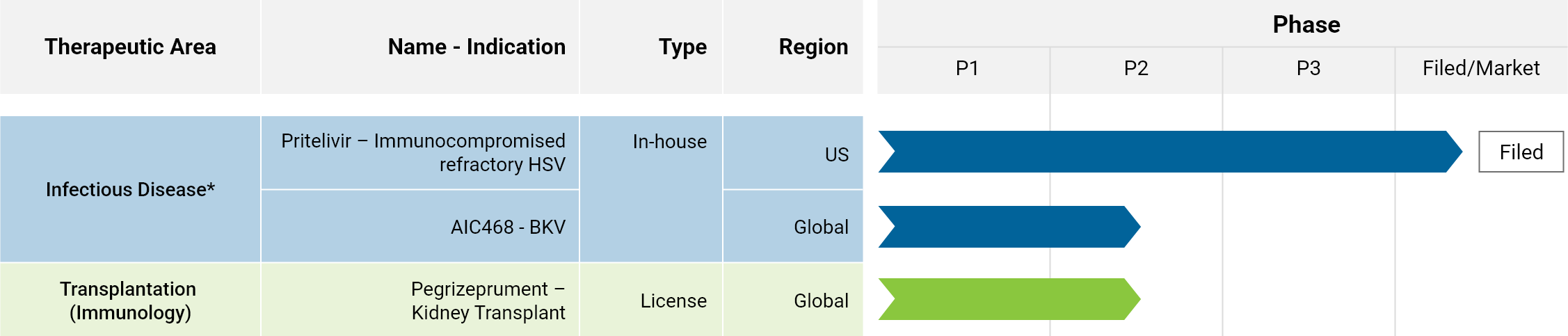
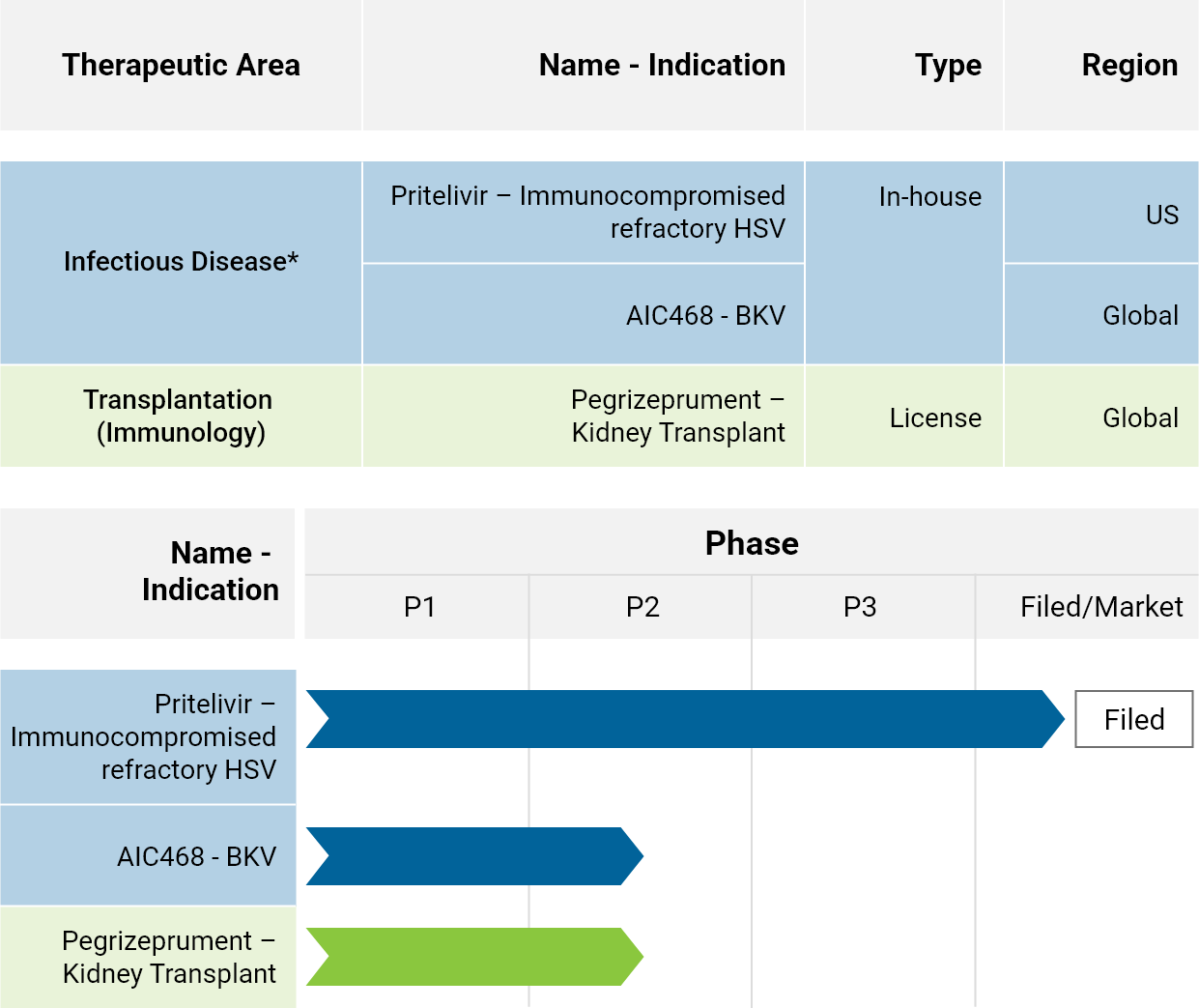
Pritelivir
- Therapeutic Area: Infectious Disease
- Name: Pritelivir
- Indication: Immunocompromised refractory HSV
- Type: In-house
- Region: US
- Phase: Filed
AIC468
- Therapeutic Area: Infectious Disease
- Name: AIC468
- Indication: BKV
- Type: In-house
- Region: Global
- Phase: 2a
Pegrizeprument
- Therapeutic Area: Transplantation (Immunology)
- Name: Pegrizeprument
- Indication: Kidney Transplant
- Type: In-house
- Region: Global
- Phase 2
*Pritelivir and AIC468 were added following Veloxis’ acquisition of Aicuris. Aicuris is the current sponsor of the regulatory applications and associated clinical trials.
BKV = BK Virus; HSV = Herpes Simplex Virus.
Pritelivir Clinical Program
Pritelivir is an innovative therapeutic candidate designed to inhibit the replication of herpes simplex virus (HSV). As a thiazolylamide-based compound, pritelivir is designed to target both HSV-1 and HSV-2 and has been evaluated for activity against treatment-refractory strains. Standard therapy for HSV infections typically involves antiviral agents such as acyclovir, that inhibit viral DNA replication. However, these treatments require activation by the viral thymidine kinase enzyme, meaning that mutations in this enzyme can lead to drug resistance — an issue that is particularly prevalent in immunocompromised patients.
Pritelivir is being investigated as a potential approach to treating HSV infection by targeting the viral helicase-primase complex, which is essential for HSV DNA synthesis. This unique mechanism may allow pritelivir to remain effective against acyclovir-resistant HSV strains, providing a potential option for difficult to treat cases if approved.
HSV commonly causes recurrent labial and genital herpes infections. While immunocompetent individuals generally manage these infections effectively, immunocompromised patients face more severe complications, including disseminated disease, keratitis, and encephalitis. Given the frequent resistance of HSV to existing drugs, new treatment options are urgently needed.
Aicuris maintains an early access program for pritelivir. Click the button below to learn more.
Early Access ProgramAIC468 Clinical Program
AIC468 is a therapeutic candidate currently being developed to treat reactivation of the BK virus (BKV) in kidney transplant recipients. The antisense oligonucleotide is aimed at disrupting BKV replication directly within infected cells, with the potential to offer a more targeted approach compared with existing treatment strategies. This unique approach may reduce the need to alter immunosuppressive therapy, thereby preserving graft function and lowering the risk of rejection.
BK virus (BKV), a common polyomavirus, infects most people in early childhood, usually without symptoms. In immunocompromised individuals, such as organ transplant recipients, BKV can reactivate and pose severe health risks. BKV reactivation is a significant risk for kidney transplant patients; if it progresses to BKV-associated nephropathy, it can result in graft dysfunction and, ultimately, graft loss. Currently, no approved antiviral treatments exist for BKV infections. The standard of care approach involves reducing immunosuppressive therapy, which increases the risk of graft rejection and transplant failure.
Pegrizeprument Clinical Program
Pegrizeprument is a pegylated monoclonal antibody fragment that binds to and blocks CD28-mediated effector-T cell costimulation, without blocking CTLA-4, an important protein found on T cells that naturally helps keep the body's immune responses in check. Pegrizeprument is, therefore, expected to have a dual mechanism of action where in a direct manner, it blocks CD28-mediated T cell activation, and indirectly, it allows for CTLA-4 mediated immunosuppressive functions. Pegrizeprument is currently being developed for the prevention of acute rejection in solid organ transplant recipients.
Pegrizeprument, also known as VEL-101 and FR104, was licensed by Veloxis Pharmaceuticals, Inc. from OSE Immunotherapeutics in April 2021. As part of the license agreement, Veloxis Pharmaceuticals, Inc. obtained worldwide rights to develop, manufacture, and commercialize pegrizeprument for all transplant indications.
Watch our video to learn more about pegrizeprument's proposed mechanism of action.
VEL-101 and Direct CD28 Costimulatory Blockade
VEL-101 IS AN INVESTIGATIONAL AGENT FOR WHICH THERE IS NO MARKETING AUTHORIZATION IN THE UNITED STATES. THE SAFETY AND EFFICACY OF VEL-101 HAS NOT BEEN ESTABLISHED. PROPOSED MOA DATA ARE BASED ON IN VITRO/IN VIVO DATA.
After an organ transplant, the immune system will target the transplanted organ for destruction.1
This involves antigen presentation by antigen-presenting cell to the T-cell receptor, known as signal 1, and costimulatory binding between the APC and T cell, known as signal 2.2
Activation of intracellular pathways triggers expression of inflammatory cytokines such as IL-2, providing signal 3 and resulting in T-cell activation, and proliferation.2
Costimulation, or signal 2, is essential in driving T-cell responses, via a complex network of signals.2
Among the best characterized and most important costimulatory interactions is CD80 and CD86 on antigen-presenting cells, with CD28 on T cells.3
CD28-mediated costimulation is integral to the immune response against a transplanted organ.3
Commonly used small molecule immunosuppressive agents act on intracellular targets. While effective, these strategies are associated with cardiometabolic, nephrotoxic, and neurotoxic side effects.2,4
Another approach to immunosuppression involves CD28 blockade through binding of CD80/86 molecules on APCs.2 This approach, however, additionally blocks CTLA-4, resulting in restoration of T-effector cell proliferation and function and may lead to allograft rejection.5,6
VEL-101, an investigational agent not yet approved for commercial use, is a pegylated monoclonal antibody fragment that specifically binds to CD28 on T cells.5
This action blocks the interaction of CD28 with CD80 and CD86, thereby attenuating T-cell activation and proliferation.5
By direct binding to CD28, VEL-101 is designed to inhibit the stimulatory effect of CD28 activation, while preserving the immunoregulatory function of CTLA-4.5 Veloxis is developing VEL-101 as an immunosuppressant medication in its pursuit of bringing novel therapies to transplant recipients.7
Video References
- Nankivell BJ, Alexander SI. Rejection of the kidney allograft. N Engl J Med. 2010;363(15):1451-1462. doi:10.1056/NEJMra0902927
- Gupta G, Womer KL. Profile of belatacept and its potential role in prevention of graft rejection following renal transplantation. Drug Des Devel Ther. 2010;4:375-382. Published 2010 Dec 1. doi:10.2147/DDDT.S10432
- Ville S, Poirier N, Blancho G, Vanhove B. Co-Stimulatory Blockade of the CD28/CD80-86/CTLA-4 Balance in Transplantation: Impact on Memory T Cells? Front Immunol. 2015;6:411. Published 2015 Aug 10. doi:10.3389/fimmu.2015.00411
- Azzi JR, Sayegh MH, Mallat SG. Calcineurin inhibitors: 40 years later, can't live without ... J Immunol. 2013;191(12):5785-5791. doi:10.4049/jimmunol.1390055
- Poirier N, Mary C, Dilek N, et al. Preclinical efficacy and immunological safety of FR104, an antagonist anti-CD28 monovalent Fab' antibody. Am J Transplant. 2012;12(10):2630-2640. doi:10.1111/j.1600-6143.2012.04164.x
- Kumar V, Shinagare AB, Rennke HG, et al. The Safety and Efficacy of Checkpoint Inhibitors in Transplant Recipients: A Case Series and Systematic Review of Literature. Oncologist. 2020;25(6):505-514. doi:10.1634/theoncologist.2019-0659
- National Library of Medicine (U.S.). (2022, May- ). A Dose Escalation Study to Evaluate the Safety, Tolerability, Pharmacokinetics, and Pharmacodynamics of VEL-101. Identifier NCT052384935. https://clinicaltrials.gov/ct2/show/NCT05238493
PEGRIZEPRUMENT IS AN INVESTIGATIONAL AGENT FOR WHICH THERE IS NO MARKETING AUTHORIZATION IN THE UNITED STATES. THE SAFETY AND EFFICACY OF PEGRIZEPRUMENT HAS NOT BEEN ESTABLISHED. PROPOSED MOA DATA ARE BASED ON IN VITRO/IN VIVO DATA.
See study publicationLet’s bring research to reality
Learn more about opportunities to partner with Veloxis.
Keep up-to-date on product pipeline and future R&D plans
Sign up for product updates and more news from Veloxis Pharmaceuticals. Your contact information will be used only for communications from Veloxis. Please review our Privacy Policy to learn more about how we use your information.